
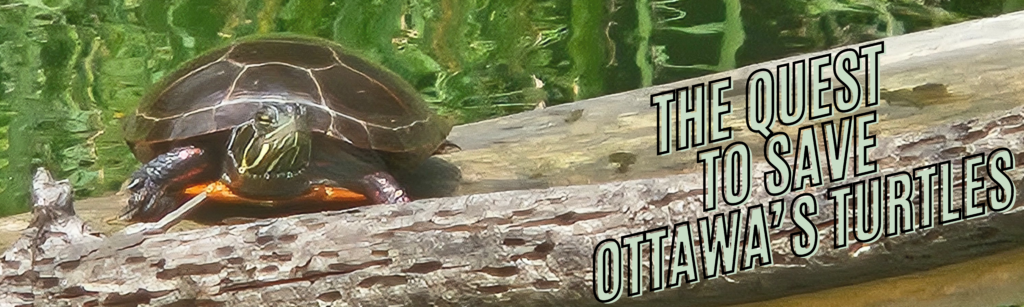
As spring approaches, a female turtle will pull herself out of the ground after a winter of brumating—a reptile’s form of hibernation. Once she reaches full maturity, she is ready to lay her eggs during nesting season.
Finding the perfect nesting spot isn’t easy—she needs loose soil and good sun exposure. As she moves along, she may choose a location near a road to lay her eggs. Very few of these eggs will hatch and survive to adulthood. Predators, habitat loss and human interference are among the reasons all eight species of turtles in Ontario are at risk.
Turtles mainly live in wetlands, marshes and along coastlines. However, 70 per cent of wetlands in southern Ontario are being turned into buildings or roads. Habitat loss is the biggest threat to turtles.
Without a proper habitat, turtles will struggle to find food, shelter and proper sites to brumate over the winter. There will be fewer nesting sites, forcing turtles to cross roads more frequently.
Over 1,400 turtles were found dead on roads in eastern Ontario between 2017 and 2020, according to the Canadian Wildlife Federation.
As turtles fight for survival, scientists and advocacy groups are studying what is putting turtles at risk and what can be done to protect them.
Repopulating turtles is a hard task. Very few turtle eggs hatch, and those that do have a low chance of reaching adulthood, mainly due to predation. Raccoons, skunks and coyotes are just a few of the mammals that eat turtle eggs and hatchlings. As a turtle grows, they are at lower risk of being eaten.
If a turtle survives to adulthood, it faces even more obstacles. This is mainly caused by human interference. The loss of just one adult turtle, especially a female, can be devastating to the population. It can take 1,500 eggs—or 59 years—to replace one adult snapping turtle, according to Turtles Kingston.
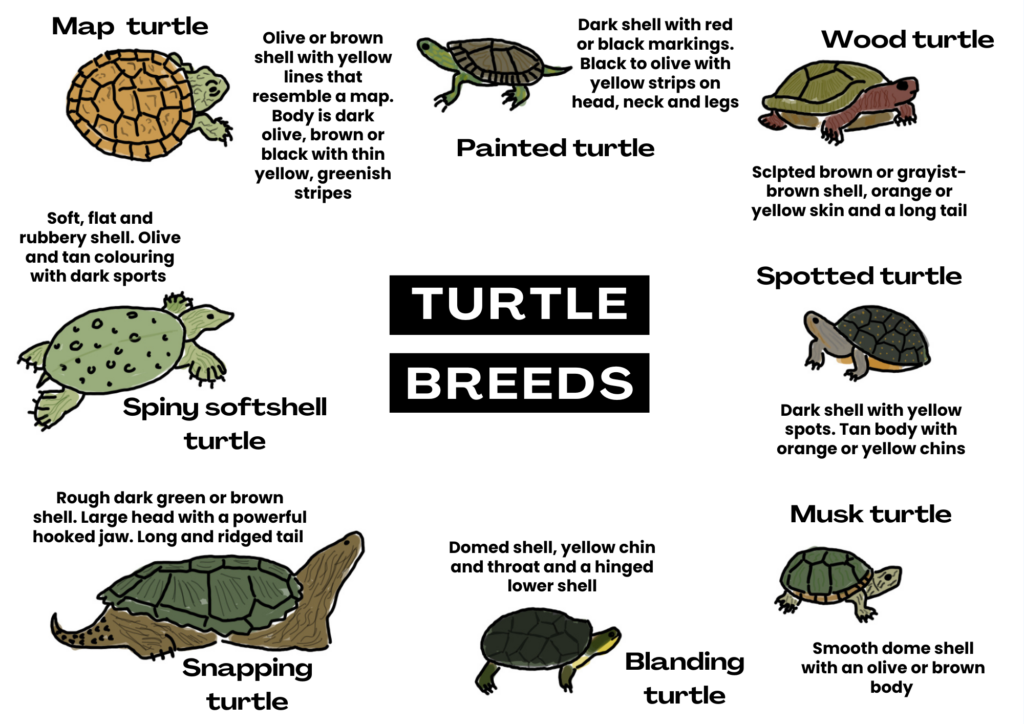
Ottawa is home to many turtles, with the four most common species being the midland painted turtle, the snapping turtle, the northern map turtle and the Blanding’s turtle.
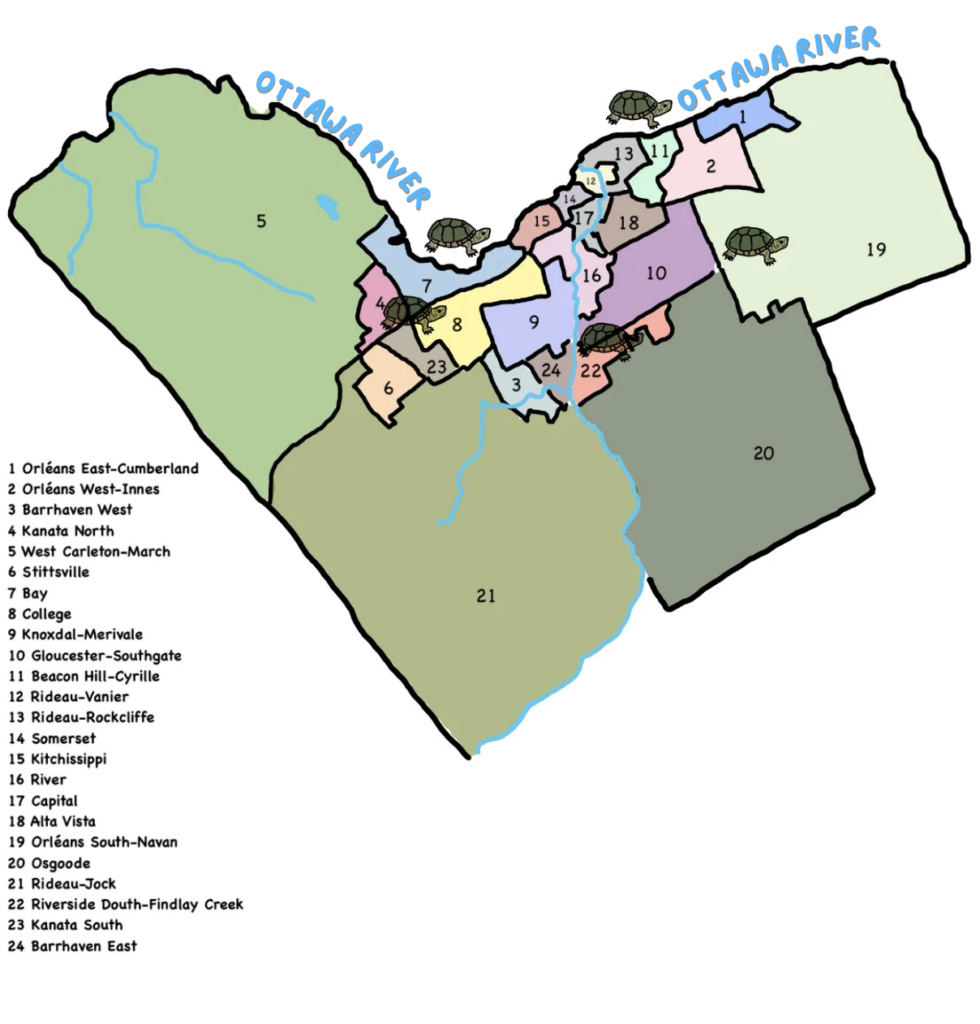
As the years go by, the turtle population has been dwindling. The Blanding’s turtle in particular has seen a severe decline in population, with 70 per cent of the population disappearing within the last decade.
Scientists in Ottawa have noticed this decline and started taking initiative. Charlotte Galloway is a master’s student at Carleton University working in the Davy Lab. The lab is run by Christina Davy, a professor and researcher at Carleton University. One of the lab’s research projects focuses on studying threatened turtle populations.
Galloway researches how human-made vibrations, such as the development of roads and buildings, affects turtle embryo development.
“We (humans) love destroying wetlands,” said Galloway. “We love putting things on and in wetlands, and that’s just sort of the number one issue there.”
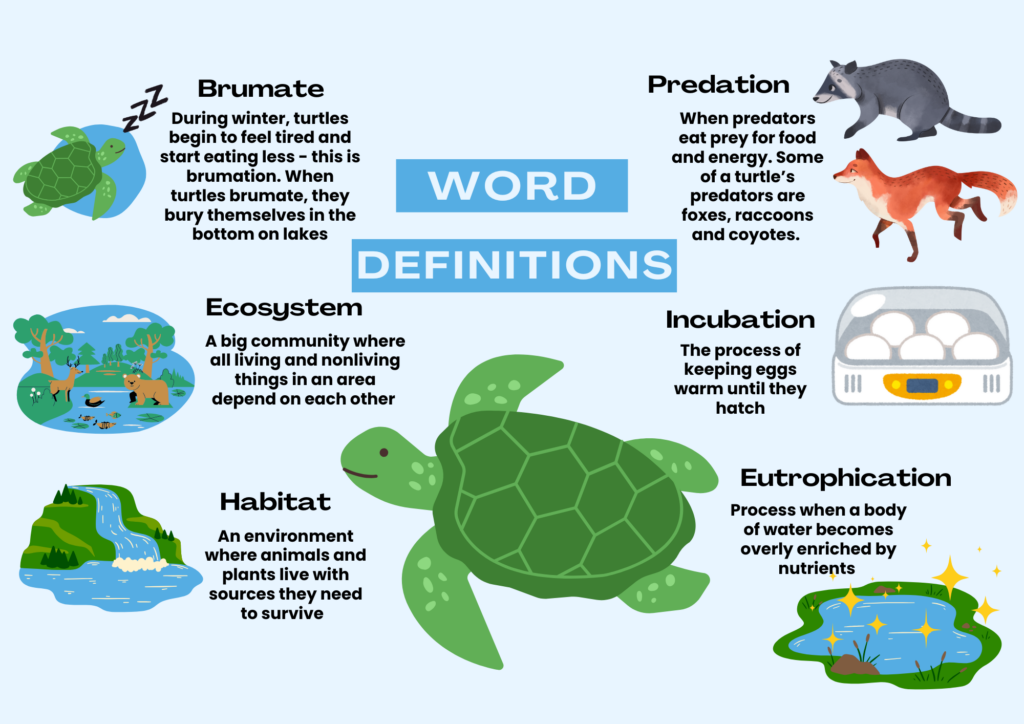
Human development doesn’t only affect turtles during nesting season. Turtles brumate over the winter, burying themselves at the bottom of frozen lakes. Galloway said humans will sometimes install pumps into lakes to prevent the water from freezing. As a result, this can disrupt turtle brumation and expose them to predators.
“There are many cottages that will put in these pumps in lakes in the winter time to help prevent freezing around their docks,” said Galloway, who noted that these allow river otters to more easily get into the no-longer-frozen lake and “cause mass mortality events of hibernating turtles.”
Habitat loss is the leading cause of turtle endangerment. Turtles, like everyone else, need a stable place to live. They rely on wetlands for food and shelter. But as humans continue to destroy these areas, turtles become more vulnerable.
Roads are often built through wetlands, forcing turtles to cross roads more often. With an increase in roads, vehicle collisions are now the second-leading cause of turtle mortality.
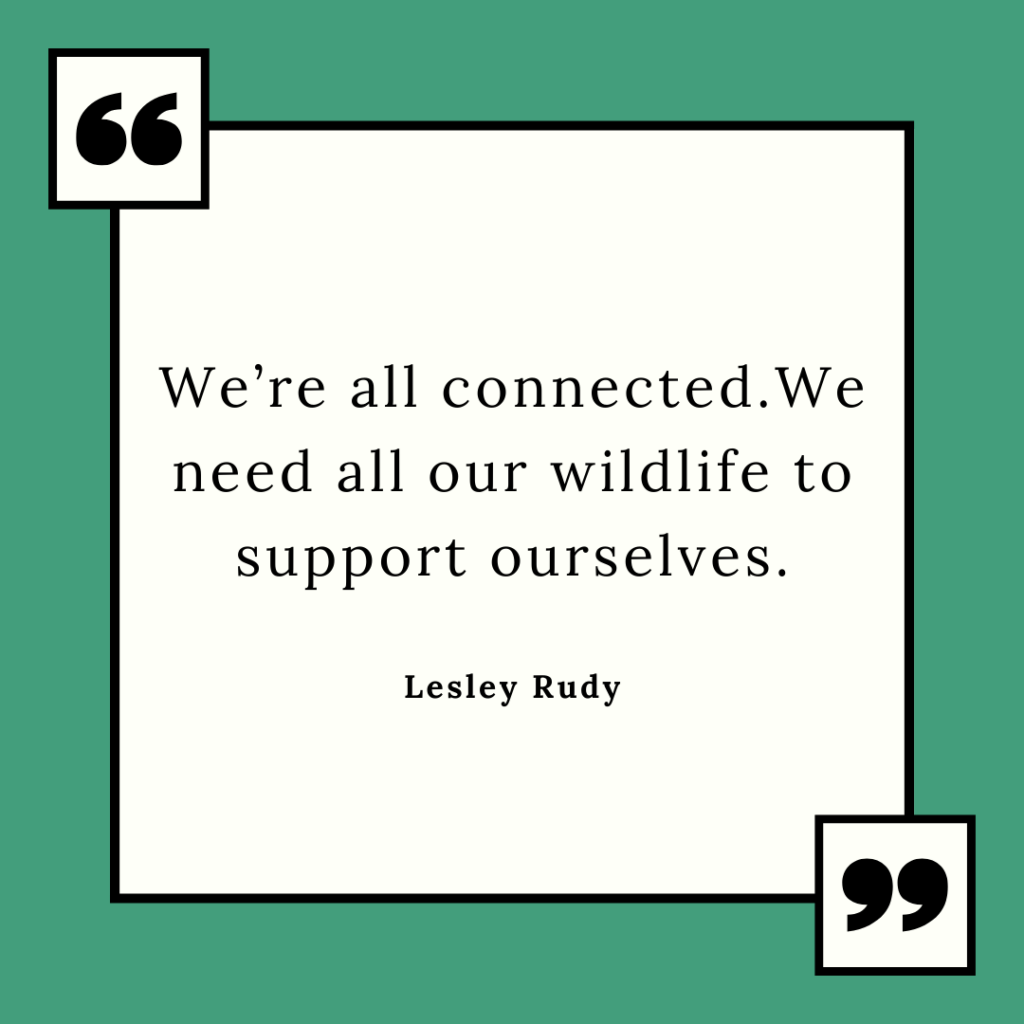
“Getting struck on roads is a problem, because as they move from area to area, and especially the females, as they come out of the water to nest at a certain time of year, often encounter roads and get struck and die that way,” said Lesley Rudy, who works for Ontario Nature and does turtle conservation work in Kingston, Ont.
While vehicle collisions are often accidents, researchers believe some collisions are done on purpose.
When a turtle is hit by a car, it may have a chance at surviving. If the injured turtle is found by a concerned citizen, it can be brought to a sanctuary to be rehabilitated.
The Rideau Valley Wildlife Sanctuary is one of many places where people can bring turtles for rehabilitation. Its mission is to help wildlife return to the wild. The sanctuary rescues various mammals, including injured turtles.
The owner of the sanctuary, Linda Laurus, said most turtles brought in are adults that have been hit by a car.
“We assess the health status of the turtles and most of them are adults hit by cars, so they have shell fractures,” said Laurus. “We mark those down for severe cases that require surgery or anesthesia. We transfer those to the Ontario Turtle Conservation Centre (OTCC). We don’t have the veterinary support in Ottawa to do surgery on turtles, so that’s why we send those to the OTCC.”
Once the turtles have undergone surgery and are recovered, they are released back into the wild. They are returned to a location one kilometre from where they were found.
“It’s especially important to get all adult animals back to their home turf,” said Laurus. “So, the Ministry of Natural Resources has set a maximum distance of one kilometre. Oftentimes there’s not an obvious source of water, so we have to track one down. Just take them out of the container and release them near the water, and they’re gone in two seconds.”
The OTCC, based in Peterborough, Ont., is Ontario’s largest rehabilitation centre for turtles. Each year, more injured turtles are brought in for care.
In 2009, between 50 and 80 turtles were brought to the OTCC. In 2023, that number had grown to 1,900 turtles, with more than 7,000 eggs incubated. Most of the turtles are admitted after being hit by a car, with half of them being females carrying eggs. To prevent reproductive loss, these eggs are collected and incubated.
Incubation is becoming a key tool in helping increase turtle populations. While predation is a nest’s biggest threat, unstable weather also plays a role in low hatch rates. Cooler summers can result in hatchlings not being fully developed by fall, when they should hatch. With the eggs that do hatch, warmer temperatures can make them be female.
Hatching turtles in a controlled environment helps ensure the eggs develop correctly and removes the risk of predation. Incubation places the eggs in a controlled environment so they hatch in a lab rather than in the wild.
Hossam Ehab also works in the Davy Lab. He studies how incubation temperatures can affect how well turtles survive in the wild.
“We’ve incubated at five temperatures, so we’ve gone from 26 C to 30 C,” said Ehab. “It seems like for the majority of the species that the intermediate temperature ranges are most ideal. They seem to produce hatchlings that are sort of the largest and have the best performance. We think that that might be better for their survival in the wild.”
To start the incubation process, scientists first need to gather eggs. To do this, the team will search for places that are suitable for nesting.
“Snapping turtles, when they finish nesting, produce what I call a beach bum,” said Galloway. “Essentially, after they’re done burying the nest, they leave these two mounds that the tail has gone through. It leaves these sorts of little bumps in the soil so you look for those. And usually, you kind of excavate around those little mounds and then you’ll find an accent cavity.”
Once a nest is found, the eggs are carefully dug up and placed in containers with a suitable substrate, such as vermiculite. Vermiculite helps regulate moisture and temperature to create an ideal incubation environment for the eggs. Back at the lab, the eggs are placed into the incubators.
“We’ll take that back to a lab, and we’ll incubate those eggs at constant temperatures,” said Ehab.
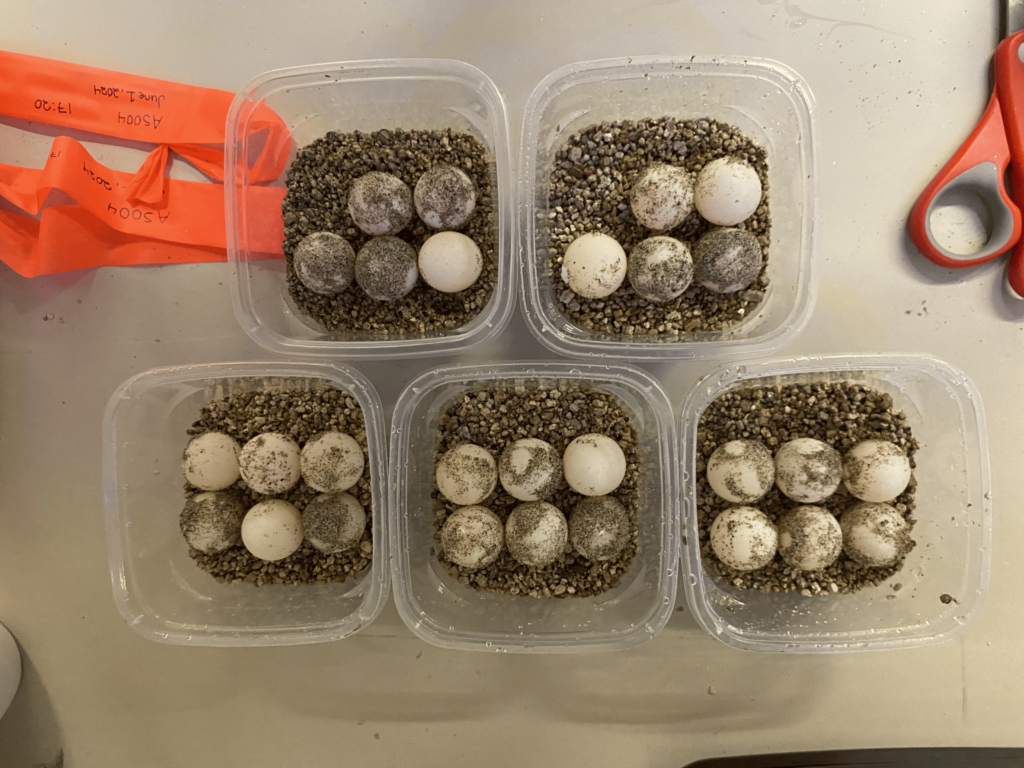
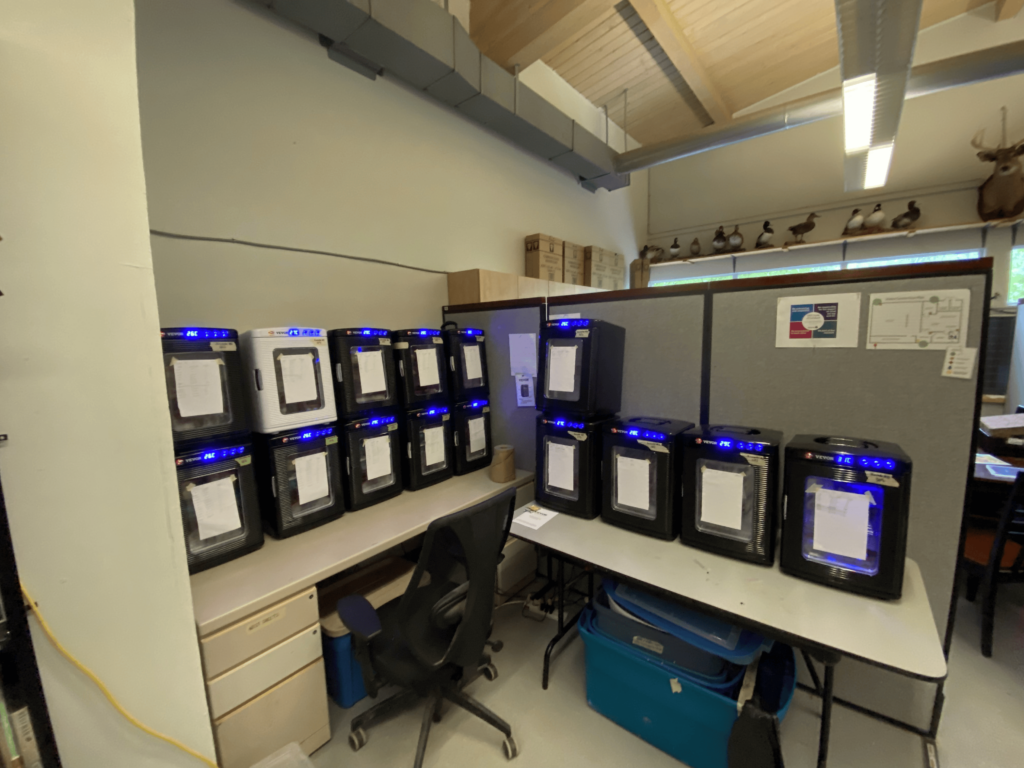
Ehab said the turtle eggs can take one month to two months to incubate, depending on the temperature.
“We monitor that throughout the process and make sure that the water conditions are maintained and the weight is maintained,” said Ehab. “And then when they start hatching, they usually are all hatched all at once.”
Galloway said 15 to 25 per cent of snapping turtle eggs hatch in the wild, whereas 95 per cent of the eggs in the lab hatch. Once the baby turtles hatch, they are released back into the wild.
“We’re already increasing the chances of turtles being able to make it to adulthood by just increasing the number of hatchlings that are going into the system,” said Galloway.
Baby turtles being released after hatching in the lab
Petrie Island is home to painted turtles, map turtles and snapping turtles. The island has a very low hatch rate, with only five per cent of eggs hatching. Friends of Petrie Island work on turtle conservation and, like the Davy Lab, incubate eggs.
In partnership with the Petrie Island Turtle Project, the Ottawa Riverkeeper and the Canadian Wildlife Federation, Friends of Petrie Island have incubated turtle eggs for the past two summers. In 2024, the project achieved an 83 per cent hatch rate, releasing over 350 baby turtles into the wild.
At the OTCC, they have seen a 65 per cent hatch rate from the eggs they collect from injured female turtles. Over 2,000 turtles are released each year by the OTCC.
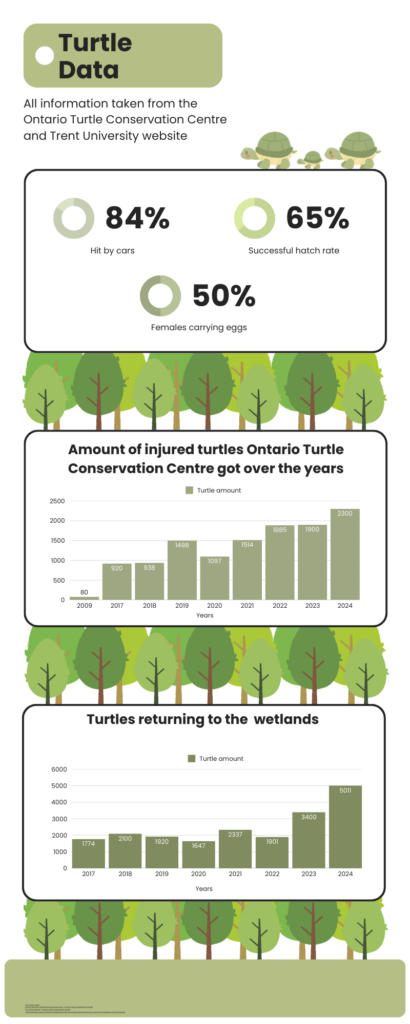
The OTCC conducts field research on the hatchlings they release into the wild by comparing them to turtles hatched in the wild. To do this, field researchers attach a tracker to the hatchlings and monitor their location. Once a month, these turtles are collected and weighed to ensure they are growing properly.
Their findings show the turtles are thriving in the wild. However, since turtles can live for many decades, there is still not enough data to see if the hatchlings will reach maturity.
Also through the field research, the OTCC monitors road mortality and turtle population growths and declines. In particular, the OTCC is interested in locating hotspots where many turtles are being hit by cars to know where eco-passages should go. Eco-passages are underpass tunnels specifically made to help wildlife cross busy roads.
Through field research, the OTCC and other organizations apply their findings to help educate people.

Turtles are often described as the cleaning crew of wetlands. Turtles are scavengers, meaning they eat a lot of dead and decaying matter. By eating this matter, the turtles are removing harmful bacteria from the wetlands, keeping the other animals living in the wetlands healthy.
Turtles also play a key role in nutrient cycling. The nutrients they receive from their food is returned to the ecosystem when they defecate, which is then absorbed by plants.
“Turtles are ecosystem engineers. They do a lot of nutrient cycling,” said Galloway.
Galloway compared turtles to elephants in the way they help their ecosystem. Elephants eat plants in forests, clearing them out and making way for new plants to grow. Turtles operate in a similar way.
“They’re scavengers. They help reduce, and sort the nutrients that die off in wetlands, and recycle a lot of it,” said Galloway.
The water quality would decrease if turtles were to go extinct, according to Turtles Kingston.
Without turtles, bodies of water would become overloaded with nutrients, leading to a process called eutrophication. This results in the overgrowth of plants and algae, which reduces oxygen levels and effectively destroys aquatic ecosystems.
Turtles have existed for over 200 million years—even alongside dinosaurs. Now, they are on the brink of extinction because of humans, according to the OTCC. This is why organizations such as the OTCC are committed to educating people on the importance of turtles.
Rudy said education is key to reducing harm towards turtles. Educating the public on proper ways to move turtles, to respect nesting areas and teaching people what to do when they come across an injured turtle is important for conservation.
Written by: Stephanie Taylor
Graphics and audio editing: Sophie Daly
Research and video editing: John Hopper
Edited by: Kimberly Tremblay